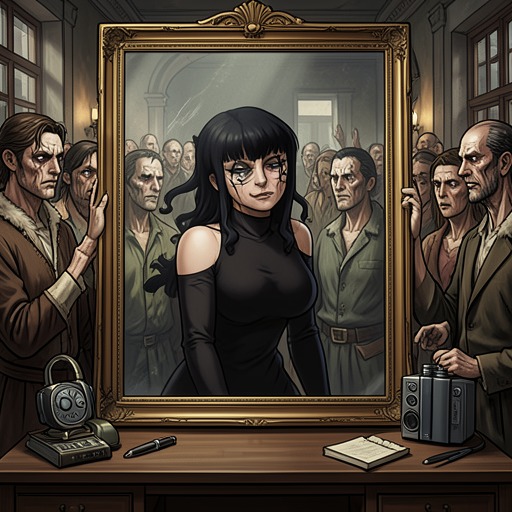
Amy McLarson
The Stars Have EyesAmy McLarson is a lawyer at McLarson’s McLawyers whose brief but consequential appearance exposes the collision between automated intellectual-property enforcement, courtroom procedure, and diplomatic privilege. She treats Maggie’s resemblance to Melinda Sparklestar as a genuine legal claim, assembles evidence with professional confidence, and helps transform a routine copyright complaint into a public spectacle that ends the moment Maggie reveals her military-backed diplomatic status.
Identity and Professional Setting
Amy is introduced as one of the two resident lawyers at McLarson’s McLawyers, working alongside her brother Ike McLarson. The siblings receive Maggie and Joe at the firm’s offices, which occupy only three rooms: a meeting room and two smaller chambers containing VR pods and computer towers. Their surroundings are modest compared with Maggie’s unusually spacious apartment, but the lawyers themselves present a polished professional image. Amy appears barely out of her teens, although gene modifications make her apparent age unreliable. She wears a sharp suit and a short, practical haircut, while her childish excitement and unrestrained enthusiasm create an unsettling contrast with her formal appearance.
Amy’s first recorded interaction with Maggie is professional and procedural. Speaking through the firm’s telephone system, she identifies the notice as an automated cease and desist generated after media-monitoring systems judged Maggie’s personal appearance too similar to that of Melinda Sparklestar. The language of the call establishes Amy as an intermediary between human lawyers and an algorithmic enforcement process: she is not claiming that she personally discovered the resemblance, but she is prepared to defend the system’s conclusion once it has produced a case file.
Building the Copyright Case
When Maggie and Joe arrive at the firm, Amy proposes reviewing the automated cease and desist again for the record. She summons a holographic keyboard, brings the case file onto the meeting room’s large wall display, and identifies a photograph that had circulated on Butterpond-4’s social-media networks approximately eight days earlier. This presentation gives the complaint a formal evidentiary shape, moving it beyond an impersonal warning and toward a prosecutable civil claim.
Amy’s preparation extends beyond the automated notice. She has hired a private investigator, who returns from Butterpond-4 with information about Maggie’s popularity in local online forums and about an anonymous donation Joe received on Maggie’s behalf during a video-game tournament. Amy presents the investigator’s findings together with online comments arguing that the donation would not have occurred if Maggie’s virtual avatar had not resembled Melinda Sparklestar so closely. She attempts to frame that resemblance as the use of a copyrighted appearance for personal gain, a strategy designed to weaken Maggie’s claim that her use was for research and therefore protected by fair use.
The argument is ambitious but legally fragile. The judge rejects Amy’s attempt to connect Maggie’s appearance to the donation, describing the claim as stretched far beyond what the evidence can support. Her defeat is not caused by a lack of preparation: she has collected photographs, social-media commentary, investigator reports, and circumstantial evidence of financial benefit. Instead, the case exposes the limits of converting algorithmic similarity and public attention into proof of actionable infringement.
The Trial and Its Spectacle
The copyright dispute becomes unexpectedly crowded because of what Joe calls the “McBored factor.” Friends, relatives, and professional acquaintances attend the proceedings as though they were watching theatrical entertainment, and the court staff are visibly excited by the chance to participate in a real trial. Amy and Ike struggle to conceal their grins, while Senior Civil Adjudicator Barnes Locker enjoys the ceremonial authority of calling the noisy room to order.
Amy makes the plaintiffs’ opening presentation and later supplies the principal evidentiary case. She summarizes the alleged infringement, then presents the data gathered by her firm and investigator. The trial is civil rather than criminal, so the investigation cannot penetrate deeply into Maggie and Joe’s private lives; nevertheless, Amy extracts enough from neighborhood message boards to establish a narrative of resemblance, popularity, and personal advantage. Her method is characteristically procedural: she does not need to prove that Maggie intended to impersonate Melinda Sparklestar if she can persuade the court that the appearance generated a benefit and therefore exceeded legitimate research use.
The courtroom’s lighthearted atmosphere makes Amy’s professional excitement part of the event itself. She and Ike are not portrayed as indifferent bureaucrats. They are thrilled by the novelty of an actual trial, and their excitement survives even when the legal argument begins to fail. That emotional investment gives Amy a double role: she is both an advocate for the copyright claim and a spectator who wants the proceeding to become as dramatic as possible.
Collapse of the Case
Maggie allows the plaintiffs’ case to advance until the judge appears ready to rule against her. Only then does she produce a different thumb drive, one bearing the digital seal of Her Immortal Majesty’s armed forces. The judge’s implants identify the seal, and he orders the contents transferred to his personal monitor. The file reveals that Maggie is a diplomat, a fact that Amy and Ike had not known before the final stage of the hearing.
Maggie’s British citizenship carries diplomatic status and protection from civil lawsuits. A felony could still expose her to criminal proceedings, but the alleged copyright infringement is a civil matter and therefore cannot proceed against her in the ordinary way. Amy’s carefully assembled case is consequently rendered irrelevant, not because every factual claim has been disproved, but because the plaintiffs lack a usable legal path against the defendant.
The reversal also reveals a procedural failure on the plaintiffs’ side. If Maggie had sent the military-signed thumb drive by courier at the beginning, the dispute would never have required a face-to-face meeting, interstellar travel, or a courtroom appearance. Amy has helped build an elaborate case whose underlying issue is eclipsed by a superior legal status that was present from the outset but withheld until the decisive moment.
Narrative Function and Significance
Amy embodies the energetic, data-driven face of ordinary law in a society where legal authority is divided among corporate enforcement systems, civil courts, military institutions, diplomatic privilege, and powers beyond human judgment. Her case begins with an algorithmic resemblance alert, develops through social-media evidence and private investigation, and ends when a military credential overrides the entire civil process. The contrast makes clear that evidence alone does not determine legal power; jurisdiction and status determine which evidence can matter.
Her appearance also sharpens the story’s recurring concern with identities that shift between human, virtual, and cosmic forms. Maggie can present a human-looking body, an avatar built from shadow and eyes, or a more openly monstrous shape, while Amy’s firm attempts to reduce that instability to a question of visual ownership. The copyright action therefore treats appearance as property even as Maggie’s diplomatic position treats her as a protected political subject. Amy’s professional confidence gives the conflict its human scale, but the case’s ending demonstrates how quickly that scale can be displaced by institutions operating under larger and more exceptional rules.